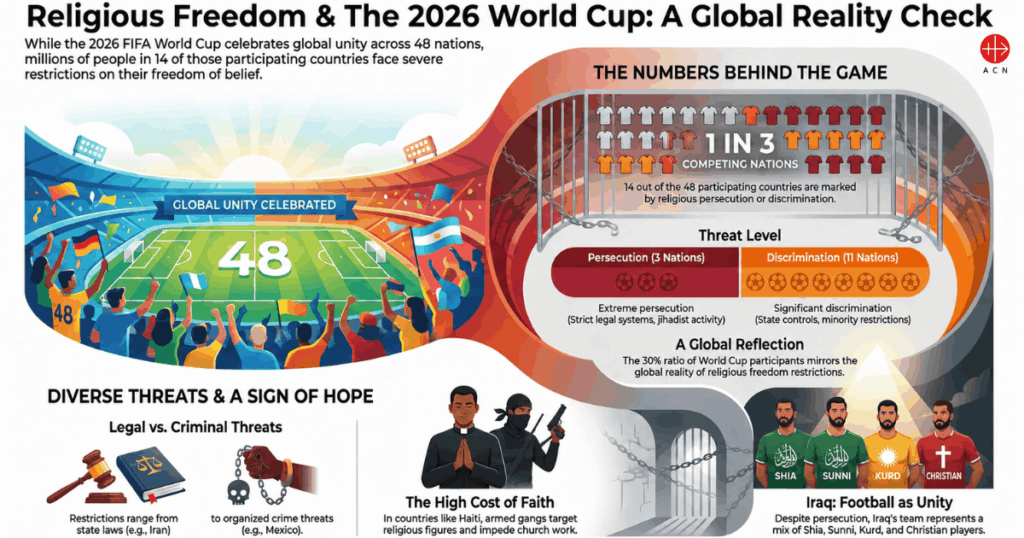
Religious freedom at the World Cup remains an elusive goal for one in every three nations competing in the 2026 tournament. The 2026 FIFA World Cup, taking place from 11 June to 19 July across the United States, Mexico, and Canada, has brought together 48 nations for the largest tournament in the competition’s history. As millions of fans around the world follow the month-long sporting event, another global reality deserves urgent attention: millions of people living in 14 of the participating countries continue to face severe restrictions on their freedom of religion or belief, according to Aid to the Church in Need’s latest Religious Freedom in the World Report (RFR). The proportion —30% of the tournament’s participants— closely mirrors the total number of countries marked in orange (discrimination) or red (persecution) on the RFR global map, representing a total of 62 out of 196 states worldwide.
Classifications and violations of religious freedom at the World Cup countries
According to ACN’s data, three of the participating countries are officially classified as places of religious persecution, and a further 11 function as countries where significant discrimination heavily affects freedom of religion or belief. In Iran and Saudi Arabia, strict interpretations of Islam underpin legal systems that severely restrict religious freedom, particularly targeting converts and members of unrecognized religious communities. Individuals who challenge these structural restrictions risk arrest, imprisonment, and, in some cases, even the death penalty.
On the other hand, the Democratic Republic of the Congo suffers from chronic instability and persistent territorial violence. The growing jihadist activity carried out by the Allied Democratic Forces (ADF) in the eastern part of the country has made living conditions and pastoral work even worse for the local population.
Cartels, gangs, and societal pressure on minorities
Mexico, one of the three host nations and the country where the tournament opened, offers a reminder that threats to freedom of religion or belief do not arise only from institutional laws. While the country has a long historical tradition of institutionalized anti-clericalism, the main contemporary concern originates from organized crime and the drug trade. Priests, religious leaders, and pastoral workers are often targeted by criminal groups seeking to exert total control over local communities in several regions of the country.
Haiti —placed in group C, with its final game scheduled to be played on 24 June in Atlanta, USA— presents an even starker picture for human rights observers. Although the country successfully qualified for the World Cup, only one member of its 26-man squad currently lives and plays inside Haiti. Large parts of the country are effectively controlled by armed gangs, which have repeatedly targeted, kidnapped, and murdered several religious figures over recent years, severely impeding the daily work of churches and faith-based organizations.
Other participating countries, including Morocco, Tunisia, Algeria, Jordan, Qatar, Egypt, and Turkey, are home to millions of people who do not fully enjoy freedom of religion or belief. Religious minorities, including Christians, Bahá’ís, and some Muslim communities, continue to face varying degrees of discrimination and restrictions in the practice and expression of their faith, often driven more by social pressure than by formal legal constraints.
Iraq’s message of unity and Uzbekistan’s controls
In this challenging global context, Iraq offers an explicit example of hope. Christians and other religious minorities have endured terrible situations of persecution over the past years and continue to complain of official discrimination. The national football team, though, has successfully become a focal point of unity, where different ethnic and religious groups are represented, including Arabs, Kurds, Shia, and Sunnis. Remarkably, four of the players are Christians. In a country where Christians now make up less than 1% of the total population, this is an outstanding achievement, as Christian players make up around 15% of the total squad.
Conversely, in Uzbekistan, strict state controls on religious activity affect people of different faiths, including members of the Muslim majority, severely limiting freedom of worship and religious expression.
Awareness and global advocacy during the tournament
According to Marta Petrosillo, director of ACN’s Centre for Studies on Religious Freedom and Editor-in-Chief of the Religious Freedom in the World Report, the World Cup is a unique opportunity to shine a global spotlight on countries where human rights are under threat:
“The World Cup brings together people from every culture, religion and nation. It is also an opportunity to raise awareness of the challenges that millions of people around the world still face in exercising their fundamental right to freedom of religion or belief. We encourage governments everywhere to uphold and protect this fundamental human right, ensuring that every person can freely practice, change or share their faith without fear of discrimination or persecution”.
Petrosillo added that while fans may passionately support different national teams on the pitch, the World Cup also serves to remind the world of the values that unite humanity: respect for human dignity and the defense of freedom of religion or belief. For individuals who wish to support this universal right, ACN has made its petition for religious freedom available online for fans and citizens to add their names.