The Diocese of La Guaira, the region hardest hit by the devastating earthquakes of June 24, is deeply immersed in national mourning, with the Catholic Church frequently serving as the only support to hold onto. The grief is immense across the country. Father Daniel Acosta, the parish priest of Tarmas—who lost his own home due to the tremors—described the daily impact of the tragedy to a delegation from the pontifical foundation Aid to the Church in Need (ACN):
«Our feelings are very mixed. We have to accompany, counsel, and support those who have suffered human losses, as well as job losses, because most of the population has lost their work. We commend ourselves with strength, asking the Lord to help us every day. In the morning we fill ourselves with His strength, with that spirit of God, to give ourselves to the service of our community. But at night the heart wrinkles, because we are human beings, and the tears come out».
The heartbreaking testimony of the clergy in the Diocese of La Guaira
The words of Father Daniel reflect the inner feelings of the bishop, priests, and religious sisters in a Diocese of La Guaira devastated by the disaster, especially when the day ends and silence allows room for memory. The parish priest expressed that the most painful losses are the lives of close friends with whom he shared years of his ministry, making it a severe blow every day to learn about the passing of well-known parishioners as the true scale of the crisis unfolds.
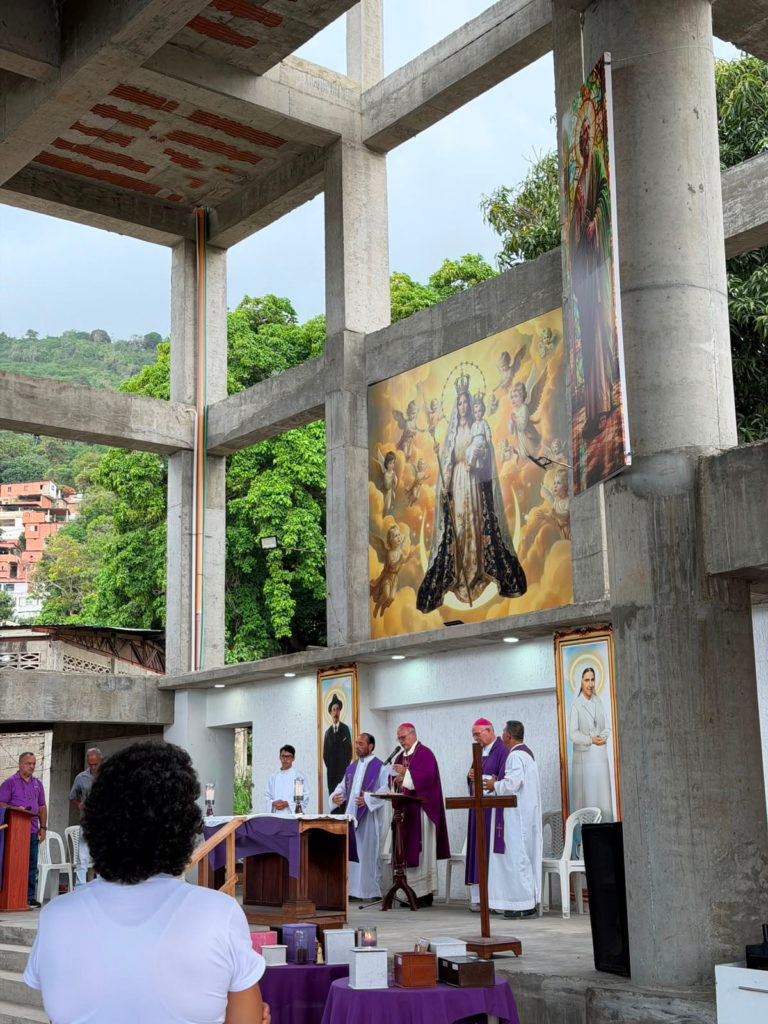
In response to the emergency, the faithful have turned to the Church in large numbers. In the parish of Nuestra Señora de la Candelaria in Caraballeda, where the temple is currently under construction and lacks both a roof and walls, the daily attendance of people seeking comfort has multiplied fivefold. The church remains open from 7:00 a.m. to 7:00 p.m., and a handwritten sign has been placed at the entrance to organize information into three distinct lists: the deceased, the missing, and the rescued. Next to the altar, on tables covered with purple cloths, rest thirteen small square wooden boxes containing the ashes of bodies recovered from the rubble, brought by families for their funeral blessings. Among the urns are the remains of Daniel’s wife, the twin sister of a parishioner named Gloria, and the parents and sister of a young woman who lost her entire family. Another urn belongs to a young girl who served as an altar server, carrying the crozier for Bishop Pablo Modesto during the feast of St. John, celebrated shortly before the disaster.
Amidst the widespread suffering, a simple embrace has become the primary source of comfort when words fail. This was visible after Mass when Archbishop Raúl Biord of Caracas—who served as Bishop of La Guaira for many years—embraced Father Daniel, whom he has known since childhood, providing a crucial moment of pastoral support and consolation.
Destroyed parishes and the profound toll of human loss
Due to the nature of the destruction, many citizens have endured highly traumatic experiences, often without the chance to say goodbye to their loved ones. In one instance, a young woman went to the morgue at the request of an injured couple in the hospital to look for their two daughters; she had to check two hundred bodies one by one until she finally found the remains of the two sisters and another mutual friend.
Similarly, Father Laudence Betancourt reported that he spent twelve consecutive hours, until two in the morning, alongside a married couple waiting for emergency teams to retrieve the bodies of their 23 and 16-year-old children from the ruins, just to offer a final blessing before they were moved. Only four hours later, at 6:00 a.m., the priest was called to another collapsed building to perform a similar service.
One of the areas that suffered the highest concentration of material and human loss was Ciudad Chávez, where the Óscar Arnulfo parish was nearly entirely destroyed. The local parish priest, Father Alfredo Bustamante, detailed the tragedy to ACN:
“It was the youngest parish, and it has been practically destroyed. 80% of my faithful have died. I have lost entire families; grandparents, parents, children, and grandchildren have left us. Only four people from the choir survived. Four of my altar servers have also died. We have lived through hell”.
Ciudad Chávez had a population of 22,500 people. Although the total death toll remains unknown, every single inhabitant has been left homeless, including Father Alfredo. The houses are collapsed, twisted like cardboard boxes, or burnt, leaving behind a severe wartime landscape in a ghost city. The regional economy, which relied heavily on tourism, the port, and the airport, was completely reduced to rubble, causing mass unemployment. Amid the total destruction, the only structure left standing was the shrine dedicated to Saint José Gregorio Hernández, the doctor of the poor; his statue fell upright from its three-meter-high pedestal, interpreted by locals as a powerful sign that he remains standing with the Venezuelan people.
The miracle of survival amidst widespread destruction
Despite the apocalyptic scenes, the tragedy also holds extraordinary stories of survival. During his homily at the Candelaria church, Bishop Pablo Modesto spoke about the miracle of remaining alive and shared his personal experience during the tremor. The bishop recalled that after seeking shelter under a door frame during the initial shock, he heard a brutal, massive roar caused by the immediate collapse of the five buildings standing right next to the diocesan seminary.
Although multiple walls of the institution collapsed completely, none of the sixteen seminarians suffered serious injuries, and they managed to evacuate the building while carrying two sick individuals on their backs. Bishop Pablo Modesto encouraged the community to hold these moments in their hearts and view life as a gift meant for the service of others:
“But in the end, it is the miracle of why we did make it and others did not. It is hard to understand it, but we must keep these things in our hearts. Just as Mary did. And to know that if God has given us life as a gift, because this has been a gift, it is to live it at the service of others, not to resign ourselves. The question is not why, but what am I alive for”.
The spirit of solidarity in the region highlights the resilience of the local population. Many of the volunteers currently managing collection centers, coordinating parish activities, and working alongside Caritas are individuals who have lost their own homes, jobs, relatives, or friends. Despite their personal grief, the community of the Diocese of La Guaira continues to provide a powerful testimony of faith and selfless service to the universal Church.