
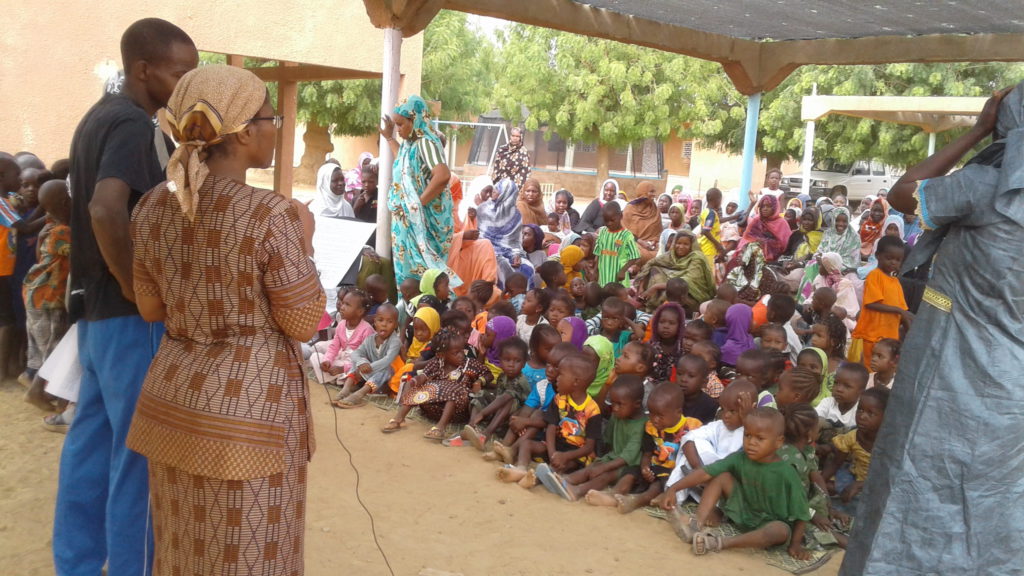
The only diocese in Mauritania has just celebrated its sixtieth anniversary. Bishop Victor Ndione, who has led the Diocese of Nouakchott for two years, tells Aid to the Church in Need (ACN) about the challenges of being a pastor in a transit country marked by illegal emigration and a lack of resources.
Uniqueness of the Church in Mauritania
Established in December 1965, the Church in Mauritania comprises around 6,000 members, exclusively foreigners from neighbouring countries like Senegal, Gambia, Mali, and Guinea Bissau. The diocese is served by 13 priests and about 30 religious sisters, all foreigners.
While the Church is not yet recognized as a legal entity, formal recognition is expected soon. Regarding religious coexistence, Bishop Ndione observes:
«In Mauritania, there is no overt persecution from Islam, which is traditionally moderate and marked by Sufism. However, we are noticing the growth of Salafist Islam, which is infiltrating the country, and which does not look kindly on the Catholic Church or on moderate Muslims».
The Migration Crisis and Professional Training
Mauritania serves as a stop-off for those dreaming of a life elsewhere. The bishop shares the tragic desperation of those who ignore the dangers of the sea:
«In the parish of Nouadhibou we had a young man who was responsible for burying the dead people who washed ashore. One would think that he would be the first to recognise the risks of this form of emigration, but he was himself drowned while attempting this impossible adventure. That caused us a lot of sadness».
In this context, the Church demonstrates charity to everyone without distinction of religion or social standing. Since the Church does not proselytize, its mission focuses on food, health, education, and professional training. Training centers in Nouakchott and Nouadhibou provide skills in baking, carpentry, and electricity to help migrants and Mauritanians find local opportunities.
The Challenge of Pastoral Mobility
Bishop Ndione compares his ministry to Sisyphus because of the constant movement of the faithful:
«The challenge of mobility also concerns the pastoral agents. All the priests are foreigners: most are missionaries and from one day to the next they could be recalled by their congregation. That’s also true for the religious sisters. (…) It’s a real concern, definitely a difficulty».
Crucial Support from ACN
Lacking legal recognition and serving a decreasing, poor population, the diocese relies on external support. Mass intentions and aid from ACN are vital for supporting religious sisters and sustaining ministry personnel. Bishop Ndione highlights the importance of a new pastoral center:
«The solidarity of the Universal Church and the support of organisations like ACN are a soothing balm and a breath of fresh air (…). ACN has helped us to rebuild a pastoral centre in Nouakchott capable of welcoming 200 people; young people and couples can come and gather, receive catechesis, prepare for marriage, and go on spiritual retreats».