
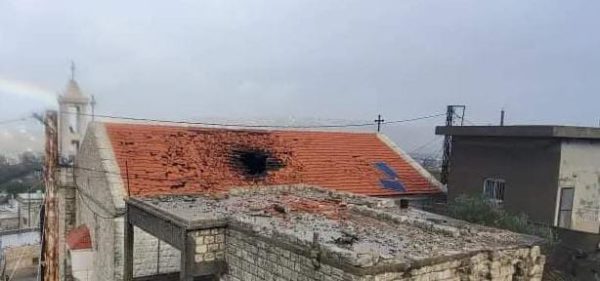
Christians of Yaroun, a border town in southern Lebanon, are currently living in fear that they will never be able to return to the land of their ancestors. Father Charles Naddaf, the parish priest of the local Greek Catholic Melkite church of Saint George, spoke to the international pontifical charity Aid to the Church in Need (ACN) about the severe concerns and hardships impacting his community. Today, the locality stands deeply wounded by the consequences of ongoing warfare.
Systematic destruction of parish infrastructure
On 1 May 2026, a devastating attack completely destroyed the parish hall, which was serving as a makeshift church, along with the parish youth center, and the convent and free school of the Melkite Basilian Salvatorian Sisters, which provided education to children of all faiths in the area. Although a ceasefire established on 17 April 2026 remains officially in effect, high tensions and ongoing fighting continue in southern Lebanon, leaving the town off-limits and making a full damage evaluation impossible.
“This is, without a doubt, one of the greatest catastrophes this community has ever suffered,” Father Naddaf tells ACN International.
Hard hopes and the future for Christians of Yaroun
Yaroun’s population is around three-quarters Shia, but it maintains a historic Melkite Christian presence close to the border with Israel. Since October 2023, the town has been heavily targeted, forcing the entire population to abandon the area for the first time on 9 October of that year. The parish church of Saint George and several homes, both Christian and Muslim, were destroyed during the initial months of the conflict.
Following the ceasefire on 27 November 2024, Yaroun was subjected to further systematic destruction, which included the demolition of the large statue of Saint George in the western part of the town. Despite the danger, 15 Christian families whose homes survived returned to make provisional repairs, turning the parish hall into a temporary chapel to celebrate the Eucharist. However, their hope was short-lived as renewed hostilities laid everything to waste once more, leading to a total evacuation on 2 March 2026.
Psychological anguish and an appeal for peace
Displaced families have sought refuge in Rmeich, Aïn Ebel in the Bint Jbeil district, and several other towns across Mount Lebanon, with Father Naddaf currently staying at the Maronite Monastery of the Annunciation in Rmeich. Beyond physical destruction and displacement, the residents’ greatest worry remains the long-term survival of Christianity in southern Lebanon.
“The Christians who have been displaced did not choose this war, all they ask is to be able to return to their homes, live in peace with everyone and remain in the land of their ancestors,” says a concerned Fr Naddaf.
The priest emphasizes that alongside the critical humanitarian emergency, the displaced face profound psychological and spiritual anguish. Families require a true return to peace and security before any reconstruction can begin, and they deeply need to know that they have not been forgotten by the global community.