The Executive President of ACN, Regina Lynch, stated that the current situation in La Guaira, Venezuela, can only be described as “apocalyptic” following the devastating earthquakes. In a briefing held shortly after returning from a field visit to the hardest-hit areas, Regina Lynch and María Lozano, ACN’s head of public communications, described a local Church that was also badly affected but has been actively responding to the urgent needs of the population.
Infrastructure resilience and the evaluation of the Executive President of ACN
The sheer scale of physical destruction across the territory caught the pontifical foundation’s delegation by surprise. Regarding her personal observations on the ground, Regina Lynch reported:
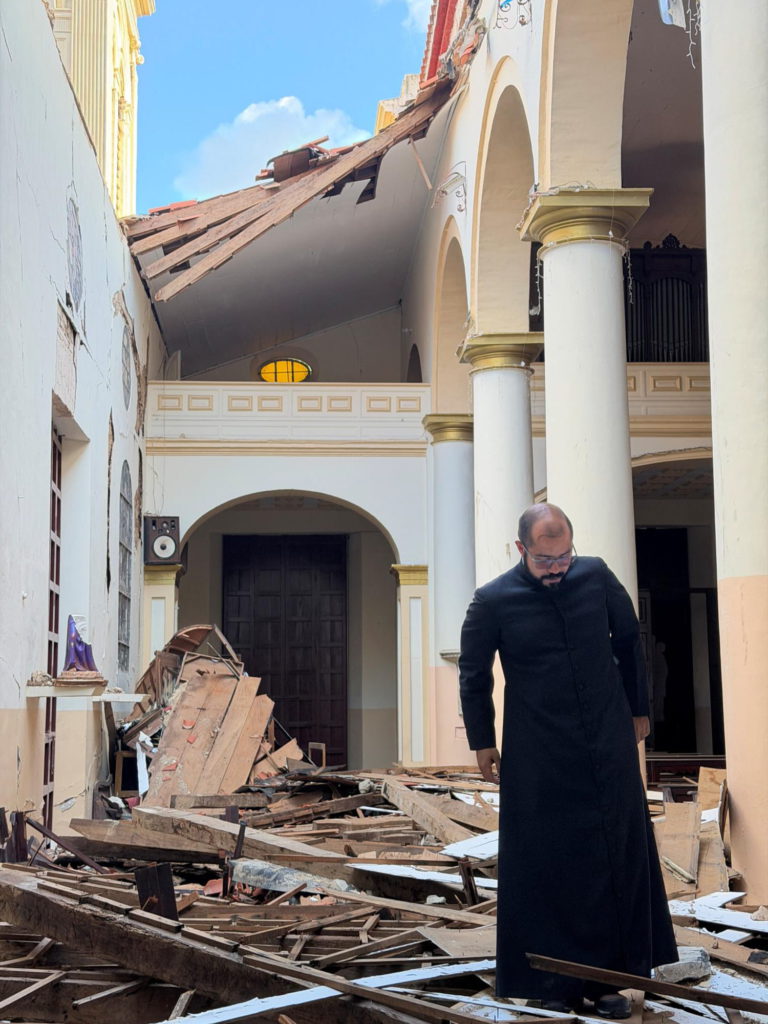
“I was not expecting this extent of destruction. When you arrive there and you see these mountains of rubble all over the city, and teams of men and bulldozers digging through the rubble – they’re not looking for survivors anymore, it’s been too long – or you just see huge tilted apartment blocks that obviously nobody can live in anymore, its apocalyptic”.
Although the official death count stands at around 4,500, institutional estimates project the actual number of fatalities to be in the tens of thousands. Additionally, several thousand people were badly wounded, and up to 500 thousand individuals are thought to have lost their jobs due to the collapse of local infrastructure.
Caritas network operations and the identity of eclesial service
During a visit to a central distribution hub in Caracas, the international delegation observed the efficiency of the local relief structures. Regina Lynch described the internal mobilization as highly effective:
“You could see how well organised the church is in Venezuela. They have a big operation there. There were so many volunteers of all sorts of ages helping to sort out what has been donated internally by other people in Venezuela. It was like a beehive”.
The Church’s ability to mobilize quickly and professionally on the ground is explained by the deep historical roots of the diocesan and parish Caritas network. María Lozano emphasized that their daily work is firmly grounded in the Gospel and closely integrated into the life of the local communities, quoting the volunteers:
«Over and over again, volunteers kept telling us, ‘We’re not an NGO. We are here and we act moved by our faith. Caritas is not understood as an independent organisation, but as an expression of the Church’s maternal care and as a concrete extension of its mission'».
Lozano added that this distinct religious identity is reflected in the specialized training the volunteers receive. In many dioceses, before actively participating in relief work, they follow a mandatory period of spiritual and biblical formation, including the study of the Sacred Scriptures and the practice of lectio divina, ensuring that their daily service is rooted in a Christian understanding of charity.
Strategic cooperation and emergency funding packages
The long-standing institutional relationship facilitated immediate action. ACN has been working closely with the dioceses of Caracas and La Guaira since 2011, when the financial and social crisis first began in the country, allowing the charity to rely on a decade and a half of cooperation and mutual trust. Lynch noted that almost all the ecclesiastical infrastructure built with the financial support of ACN over this period successfully resisted the earthquake, while entire civil housing blocks completely collapsed.
“Thank goodness the Church is there in Venezuela. The money already sent is being used to support the priests and the sisters and the laity who are working now with the victims”.
As soon as news emerged about the true scope of the tragedy, ACN pledged an initial support package of 100 thousand euros, but long-term structural plans are already being finalized. These include assisting tens of thousands of displaced people currently living in temporary tents in the streets. The Church continues to serve them, including through the celebration of the sacraments, but there is growing concern that as time goes by, they will become restless, while the international community’s attention begins to drift away from the country.
Long-term support for trauma healing and reconstruction
ACN plans to remain with the Venezuelan people through the local Church for the long haul. The foundation estimates that it will be necessary to fund the physical reconstruction of destroyed Church buildings, but also to provide professional trauma healing. Regina Lynch highlighted a specific medical center during her tour:
“We visited one clinic in La Guaira run by the Church which is open 24 hours. Some of their staff members had lost their families and their homes, two of the doctors who worked there were killed, and that morning an expert in trauma healing had come from Caracas and they were given training. Firstly, they were helping the staff there themselves who suffered trauma and then helping them to help the people who were coming to them for further support. We have indicated to the bishops that, of course, if they need more help, they know we are here”.
Severe psychological trauma is widespread among the survivors. María Lozano recounted meeting Gismely, a 31-year-old woman who survived a fall from a twelfth floor during the earthquake. Although she was rescued from the rubble, she lost a leg due to her injuries. Thanks to the personal support and deep faith of a Caritas volunteer, Gismely was able to smile again, telling the delegation: “I know it’s not going to be easy without my leg, but my life is more than that”. ACN formally assured her of their continuous prayers. Lozano also reported the case of a father and his three children who found shelter in a home run by the Carmelite nuns after losing 40 members of their family, including the mother.
Many Church members have also suffered immense personal and material losses. Father Alfredo lost 80% of his parishioners, while Bishop Pablo Modesto of La Guaira opened his bedroom door to discover that his office and the side of the seminary building had completely disappeared, as had several entire buildings next to it. Spared along with his seminarians, the Bishop of La Guaira focused on their future reconstruction mission:
“We are here to rebuild this country, and I think this is one of the most important jobs for the Church now”.