
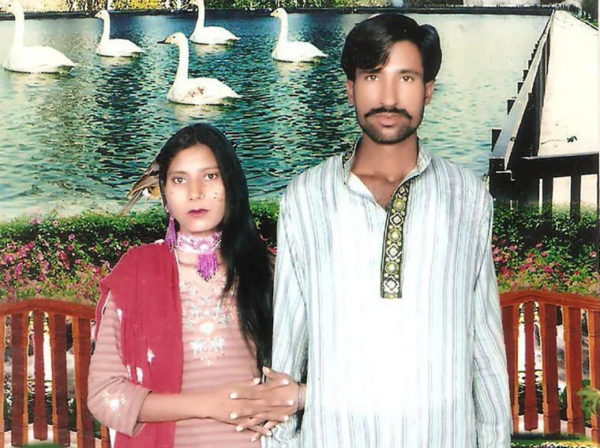
Bishops in Pakistan have spoken of their dismay after the country’s Supreme Court quashed the sentences of three men convicted of killing a Christian man and his pregnant wife who were burnt to death after being thrown into a brick kiln. In interviews with Catholic charity Aid to the Church in Need (ACN), Bishops Samson Shukardin and Indrias Rehmat said that the release of the men cleared of killing Shahzad Masih and Shama Bibi formed part of a pattern in which Christians and other minorities are routinely denied justice following violence against them.
The Supreme Court overturned the death sentences of the three remaining convicts last Friday, 10th July, alleging flaws in the evidence and a weak prosecution. Pakistan’s top court went further by dismissing the Punjab Provincial Government’s appeal against the prior acquittal of 102 people accused of complicity in the atrocities committed against the young couple. The case dates back to November 2014 in Kot Radha Kishan, south of Lahore, where a mob acting on false accusations of blasphemy severely tortured Shahzad and Shama before burning them alive inside a brick kiln. Although police originally registered the case against hundreds of suspects and five were subsequently sentenced to death, two were previously freed by the court of appeals, leaving the remaining three completely acquitted by the Supreme Court’s recent ruling.
Systemic impunity denounced by Bishops in Pakistan
Reacting to the controversial judicial decision, Bishop Shukardin, President of the Catholic Bishops’ Conference of Pakistan and Bishop of Hyderabad, highlighted the collective despair of the community:
“Shahzad and his wife, Shama, who was pregnant, were thrown into the fire alive. In the end, what is the result of all these efforts towards justice? People feel they have no voice – that no-one is listening. They cry to be heard.”
Bishop Rehmat of Faisalabad additionally shared his disappointment regarding the historical patterns of discrimination in the country:
“We are deeply disappointed that after 12 years history has yet again repeated itself – those who have suffered are the ones who suffer yet more discrimination and humiliation.”
Both bishops emphasized that the Supreme Court’s decision is not an isolated incident, but represents one of many cases of institutional injustice against religious minorities. They alleged that while fast arrests are typically made by local authorities following violent public incidents, the vast majority of suspects are gradually released as charges are dropped or initial convictions are systematically overturned.
The Jaranwala attacks and structural police failures
Bishop Rehmat spoke out against a recent ruling on Monday, 13th July, by the Anti-Terrorism Court in Faisalabad. The court sentenced a single man to 10 years in prison for using a crane to damage church infrastructure, but simultaneously acquitted 12 others accused of active participation in the August 2023 riots in Jaranwala, Punjab. During those disturbances, 26 church buildings and more than 80 Christian homes were attacked and desecrated. Commenting on the acquittals, Bishop Rehmat stated:
“Those accused of carrying out the attacks in Jaranwala are given the benefit of the doubt. Those who destroy our churches, desecrate our Holy Bibles and burn our homes are given freedom. On the other hand, those who suffer pain and tragedy are given no hope. They are abandoned.”
Bishop Shukardin strongly backed these concerns, referencing a public statement released by the National Catholic Commission for Justice and Peace (NCJP). The advocacy organization, chaired by the bishop himself, denounced a continuing pattern that grants structural impunity to perpetrators of heinous crimes against religious minorities. He explicitly blamed repeated police failures to properly compile criminal cases as the main reason why courts lack the necessary evidence to convict guilty parties:
“The police are the main people who should produce the evidence. The court will pay attention to what the police say. The reality of what happens is often serious and such cases strongly demand justice but the evidence is weak.”
Furthermore, the prelate noted that Christians and other vulnerable groups remain deeply frightened to appeal for legal justice due to the imminent threat of violent retaliation, adding that those who dare to speak out place their own lives in extreme danger. Bishop Shukardin concluded by urging Western governments to actively challenge Pakistan to protect religious freedom, noting that foreign diplomatic delegations frequently limit their visits to political meetings in Islamabad without witnessing the raw reality faced by communities on the ground. Both bishops expressed their gratitude to ACN for shining a light on persecution, noting that international awareness remains crucial in their ongoing struggle for justice.