
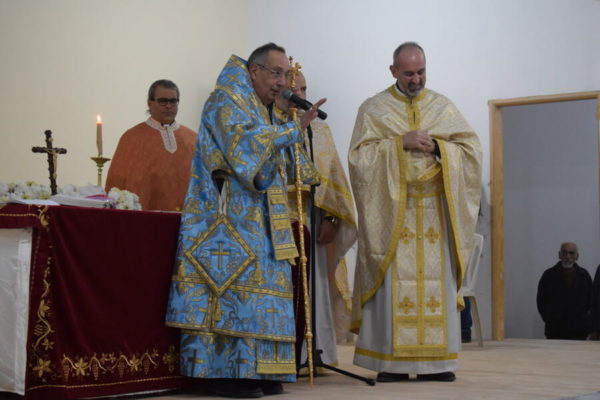
The Archbishop of Homs, Melkite Greek Catholic prelate Jean-Abdo Arbach, confirms to Aid to the Church in Need (ACN) that he is safe and expresses gratitude for the prayers he has received after being tied up and robbed in his office. Meanwhile, the Patriarchs of the Churches in Syria warn of growing insecurity affecting Christians across the country.
Archbishop Jean-Abdo Arbach was subjected to a violent attack on Saturday, 14 November, when several men entered his office, tied him up, and gagged him. The assailants ransacked the office and stole several personal belongings, including an image of the Virgin Mary.
In a telephone conversation with ACN on Tuesday, 17 November, the Archbishop of Homs confirmed that he was safe, repeatedly thanked God for having escaped unharmed, and expressed his trust in God’s help to endure this difficult experience. He also conveyed his gratitude for the prayers and messages of solidarity he had received. The prelate explained that investigations are still ongoing and that he hopes further details about the incident will emerge in the coming days, preferring not to comment further for the time being until the circumstances surrounding the attack have been clarified.
ACN Executive President Regina Lynch expressed her deep shock at the incident and her solidarity with the Archbishop of Homs:
“We were deeply shocked to hear of the attack on Archbishop Arbach, a courageous shepherd who has remained close to his people throughout so many years of war and suffering. We thank God that he is safe and assure him of our prayers and solidarity. Our thoughts are also with all those who continue to live in fear and insecurity in Syria. We sincerely hope that the country will finally find the peace and stability its people so desperately need”.
Archbishop Arbach has worked closely with ACN for many years, helping to draw international attention to the suffering of the Syrian people and the challenges facing the country’s Christian communities. During the years of war, ACN has supported the prelate through numerous projects in the Homs region, including emergency assistance, education, medical care, and the reconstruction of homes and Church buildings.
Patriarchs warn of growing insecurity
The attack has prompted a strong reaction from Church leaders in Syria and neighbouring Lebanon. In a joint statement issued on 17 November, the three Patriarchs of the Melkite Greek Catholic, Greek Orthodox, and Syriac Orthodox Churches condemned the attack and warned of a series of violent incidents affecting the Syrian population, particularly Christians.
The statement, signed by Patriarchs Youssef I Absi, John X, and Ignatius Aphrem II, refers to recent assaults and kidnappings, as well as attacks reported in March and October this year in Al-Suqaylabiyah, a predominantly Christian town, which ACN had previously reported on. The Patriarchs express deep concern about insecurity and the future of Christians in the country, and call on the authorities to investigate the attacks, identify those responsible, and take effective measures to protect the population. They also reaffirm their commitment to peaceful coexistence between Christians and Muslims, based on equal rights and responsibilities for all citizens.
The Archbishop of Homs, a voice committed to peace and reconciliation
In March 2025, following a new wave of violence in western Syria, the Archbishop of Homs told ACN:
“We don’t want any more bloodshed. We call for unity and reconciliation. After 14 years of war, we don’t need another conflict”.
On that occasion, Archbishop Arbach also thanked the foundation for its support for the Church’s work in Syria, particularly through the distribution of food and medicine, assistance with accommodation, and spiritual support for Christian families.
“At ACN, we wish to reaffirm our closeness to Archbishop Arbach and to all those suffering the consequences of violence in Syria. We join the country’s Church leaders in their appeal to ensure the safety of all citizens and to work towards lasting peace,” concluded Regina Lynch.