
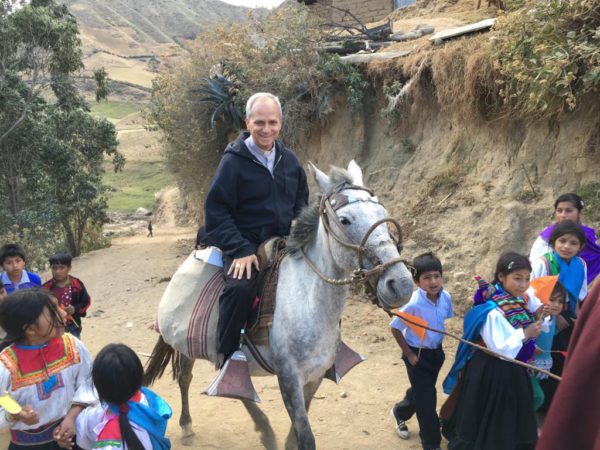
Latin American bishops from the Church in Uruguay, Argentina, and Peru do not hide their excitement over the upcoming visit of Pope Leo XIV, scheduled from 6 to 17 November, even as they face very different realities and share a common concern over his health. Leo XIV will visit three countries and ten cities, beginning his journey in Uruguay, leaving on 8 November for Argentina, visiting Peru from 11 to 16 November, and arriving back in Rome on 17 November.
During an online conference organized by the pontifical charity Aid to the Church in Need (ACN), three bishops—one from each host country—spoke about the specific realities and challenges Leo XIV will encounter.
The secular challenge in Uruguay
Cardinal Daniel Sturla, Archbishop of Montevideo, explained that Uruguay stands in contrast to the rest of Latin America due to its high level of secularism:
“Over the past century, since 1929, Uruguay has gone through a period of strong secularism. Only 33 per cent of Uruguay’s 3.5 million people identify as Catholics, 28 per cent believe in God, but do not belong to a specific church, and another 28 per cent are agnostic or atheists, with 11 per cent claiming a different religion”.
This environment leads to peculiar phenomena where Christian celebrations are kept but renamed, such as Christmas becoming the Day of the Family and Easter being called the Week of Tourism. In this context, Cardinal Sturla added:
“The Church is free to operate, but it occupies a secondary place. Our Church is poor and small, but free and beautiful. Being a priest here is a service offered with modesty, there is no prestige attached, which leaves the priest free to lead a normal life and be devoted to his tasks”.
“We are waiting for the Pope with much hope and love, and closely cooperating with the state”.
Argentina focuses on youth and Peru welcomes the Pope home
Even though Pope Francis was Argentinian, it has been almost 30 years since the country last received a Papal visit. Auxiliary bishop Alejandro Musolino of Cordoba shared that the local Church is expecting a massive turnout of youth, planning three large outdoor masses following a recent pilgrimage to Luján that gathered around 2.8 million people. Emphasizing the spiritual needs of young people post-pandemic, Bishop Musolino stated:
“Today, spiritual strength is a source of hope. Above all, the fact that the Church created spaces where young people can take the lead seems to have helped them feel they belong, that their voices matter, that their actions matter, and that the missionary spirit is vital”.
In Peru, the greatest excitement is felt in Chiclayo, the diocese where Pope Leo was bishop for eight years. His successor, Bishop Edinson Farfán, noted:
“He is coming home, when he comes to Peru. We don’t need to introduce the country to him, he knows everything about the Peruvian Church”.
Bishop Farfán highlighted that the Pope will deliver a message of communion and dialogue grounded in the Trinitarian mystery, becoming the first Pope to celebrate mass in the Peruvian Amazon while addressing local issues like corruption and the strengthening of democracy.
The Pope’s health and a continent of vibrant faith
Pope Leo has just undergone surgery to remove a malignant nodule on his lung. While the Vatican confirmed the trip remains on the agenda, all the bishops stressed that his health and speedy recovery should be the first priority so that he may confirm the faithful in good health.
Luis Vildoso, ACN’s director of projects for Latin America, provided context on the continent’s vibrant Catholicism, noting that the Americas house about 48% of the world’s Catholics. The region faces unique challenges, including vast territories and a high faithful-to-priest ratio, with one priest accompanying an average of 7,500 Catholics.
From 2021 to October 2026, ACN allocated more than €13.4 million to support the Church in Peru, Argentina, and Uruguay, funding 903 pastoral projects. This critical support includes formation programs, infrastructure construction, religious literature, transportation, and sustenance for priests and religious in some of the most remote and vulnerable areas.