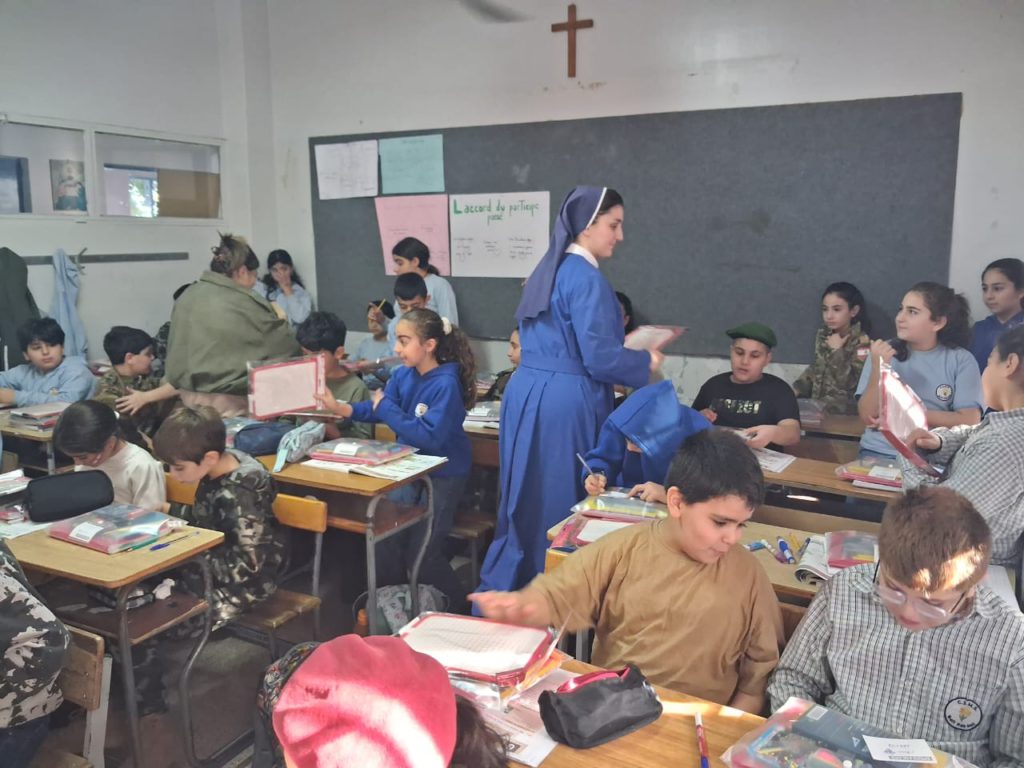
Christian schools in the Middle East are receiving vital support from Aid to the Church in Need (ACN) to keep their doors open amidst ongoing wars and escalating instability. While September typically marks the start of the academic year across the northern hemisphere, returning to classes in this region presents severe economic and operational hurdles. The presence of Christian educational institutions is essential for maintaining the stability of local Christian communities and fostering interreligious coexistence, as these schools serve both Christian students and members of other faith groups.
Across the Holy Land, Syria, and Lebanon, ACN helps more than 15,000 students remain in over 200 Christian schools, while providing financial support to nearly 2,500 teachers.
The crucial role of Christian schools in the Middle East and the Lebanese crisis
Lebanon is the primary recipient of ACN’s educational aid. Following the collapse of the banking system in 2021, many families lost their savings and could no longer afford tuition fees. ACN stepped in to cover tuition costs for nearly 13,500 students and provide salary subsidies for over 1,000 teachers across roughly 170 schools. Marielle Boutros, ACN project coordinator for Lebanon, reflects on the worsening conditions:
“The situation five years ago was really very bad, and we had little hope for the future. If you’d asked us, we’d say we didn’t know how things might be in a further five years. But we didn’t imagine that it would go this far”.
“In 2024 we had displacement, and in the south of Lebanon people were not able to pay tuition fees, many of them lost access to their agricultural fields. But the 2026 war has been worse, because some damages are irreparable. It’s not that people don’t have access to their lands, it’s that there is nothing to go back to”.
“We are still in a state of war, and nobody knows what is going to happen. If you are a parent, even in a safer area, you are not going to spend the little you have on tuition fees when you can’t be sure if you will have the money to feed your family”.
“And then we have the schools in the affected areas. The teachers have to be paid, in order to maintain their link to the school and avoid losing them, because we don’t have a pool of talented teachers as we did before, due to emigration”.
Persistent uncertainty in Syria and government pressure in the Holy Land
Regarding Syria, Boutros notes that the situation remains characterized by pervasive uncertainty alongside deep economic hardship, making continued emergency support essential.
In the Holy Land, Christian institutions face regulatory challenges from Israeli authorities. A law passed in January bans new teachers with diplomas from West Bank universities from teaching in Israeli schools, while entry permits for West Bank residents were recently left unrenewed. Following a strike declared by Christian schools, authorities renewed some permits, though often for short durations of a few weeks.
Ecclesial educational networks—such as the Latin Patriarchate of Jerusalem, which operates 43 schools and 35 kindergartens serving 20,000 students—remain key beneficiaries. Between 2025 and 2026, Aid to the Church in Need allocated approximately €2.6 million for regional education projects: nearly €1.6 million for Lebanon, around €585,000 for Syria, and €420,000 for the Holy Land.