
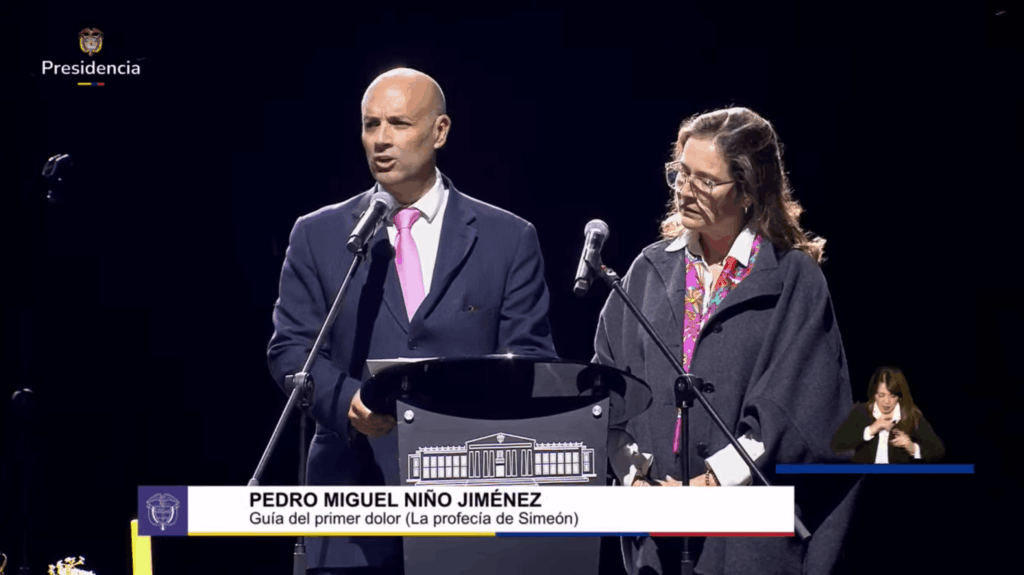
Religious freedom in Colombia forms the central focus of a statement released by Pedro Miguel Niño, president of ACN Colombia (Aid to the Church in Need), following his participation in the National Day of Prayer for earthquake victims alongside Catholic leaders and members of various religious denominations. The event, coupled with actions during the presidential inauguration, sparked public debate while prompting many citizens to defend the president’s right to publicly express his faith. Drawing from Aid to the Church in Need (ACN) insights in its Religious Freedom in the World Report, the executive shared essential considerations.
Defending faith and the rights of elected leaders
The ACN president emphasized that holding public office must not diminish an individual’s fundamental rights or personal convictions:
“We cannot turn our leaders into second-class citizens. It is unacceptable to demand that, simply because they were elected to public office, they should lose the rights shared by all other inhabitants of the country. One of those fundamental rights is every person’s right to live according to their faith. A president does not forfeit religious freedom by becoming president”.
“We cannot force a nation that elects a leader based on specific proposals, values, and faith to expect that leader to conceal their faith as soon as they take office. That would disrespect the popular will. If citizens were aware of their values, convictions, and faith when voting, it cannot be expected that they must hide them upon assuming power”.
“Freedom that is not defended is the first to be lost. We have seen this repeatedly. Our democracies are fragile, and we have witnessed with sadness what has transpired in Nicaragua, Cuba, and Venezuela, to name just a few neighboring countries. Freedoms begin to erode when society stops defending them clearly”.
Core principles of religious freedom in Colombia
The declaration stresses that religious freedom extends far beyond mere freedom of worship, standing as a universally recognized human right enshrined in Article 18 of the Universal Declaration of Human Rights. This framework guarantees the right to hold, adopt, or change religion, as well as to manifest, teach, and practice it individually or in community, both privately and publicly.
“Religious freedom does not merely protect the right to believe or simply enter a place of worship. It also protects the right to live publicly and coherently in accordance with one’s faith”.
Social impact, conscience, and family rights
This fundamental freedom carries concrete implications across societal sectors:
-
Family education: The primary right of parents to educate their children according to their faith and convictions.
-
Conscience in healthcare: Protecting doctors and medical professionals who face employment discrimination or pressure regarding abortion.
-
Public service: Safeguarding public servants from coercion contrary to their deeply held beliefs.
“We are not discussing a concession granted by the State to believers. We are talking about a fundamental human right. That is why we must defend it clearly. Because the freedom that is not defended is the first to be lost”.